Home About News Sponsors

SAEINDIA is an affiliate society of SAE International, registered as an Indian non-profit engineering and scientific society dedicated to the advancement of the mobility community in India. Out of many student-centered programmes it runs, REEV INDIA — the Range Extended Electric Vehicle competition — is one of its flagship OEM-style vehicle development events, run by the SAEINDIA Bengaluru Section since 2019.

2019Founded
4thEdition, 2026–27
6Engineering disciplines
₹1,50,000Top prize
Who runs REEV

About SAEINDIA.

SAEINDIA is an affiliate society of SAE International, registered as an Indian non-profit engineering and scientific society dedicated to the advancement of the mobility community in India. It operates as a network of Sections across the country — REEV runs under the SAEINDIA Bengaluru Section — connecting India's engineering student community to industry practice through student design competitions, technical conferences, publications and professional development programmes.

Its student competitions span every corner of mobility engineering — from Aero Design to Supra racecars and REEV's own range-extended electric vehicle brief — each one built to put a student team through a compressed, real version of an OEM product development cycle.

The parent body

About SAE International.

SAE International's mission is to advance mobility knowledge and solutions for the benefit of humanity. Founded in January 1905 in New York as the Society of Automobile Engineers — by thirty pioneering engineers, with Andrew Riker as its first president and Henry Ford as vice president — it's grown into a global professional association and standards-development body of more than 138,000 engineers and technical experts across the automotive, aerospace and commercial vehicle industries, from students through to senior fellows.

In 1916 it absorbed the Society of Aeronautical Engineers — the first step in a scope that would eventually earn it the "International" in its name. Many of the technical standards it publishes today are used worldwide as the baseline for design, safety and testing practice — REEV's own rulebook and judging criteria draw on this same standards culture, so a student walking out of REEV has already worked, in miniature, the way the industry they're about to join actually operates.

Six years on track

REEV's journey, one edition at a time.

From a single awareness workshop to a national, software-first vehicle development season.

1
2019

Awareness workshop

SAEINDIA Bengaluru Section runs an awareness workshop on range-extended electric vehicles — the seed REEV grows from.

2
2020

1st Edition

REEV's first scored edition arrives after 18 months of work with founding partners General Motors' Technical Centre India and TVS Motor — two names still in REEV's partners row today.

3
2022

2nd Edition — Christ University

1st Runner-up finish, and the competition's scope keeps widening across more colleges.

4
2026

3rd Edition — GITAM University

The largest edition yet — 2nd Runner-up finish, record participation, and an Electrical Vehicle Centre of Excellence inaugurated on campus.

5
2026–27

REEV 4.0 — now

A standardized engine/motor spec and dual-battery Open VCU software control — a season that rewards control strategy as much as fabrication.

REEV INDIA objectives

An OEM-grade engineering programme, run for students.

Built around range and fuel efficiency — the technologies reshaping the auto industry today.

REEV — Range Extended Electric Vehicle — exists to give engineering students a genuine, hands-on run at OEM-style vehicle development, years before they'd get that exposure on the job. It pushes teams through the same technologies reshaping the auto industry today: hybridization, light-weighting, energy optimization, and range extension.

Students from Computer Science, Electrical, Electronics, Mechanical, Automobile and Production backgrounds form a single cross-functional team and take a vehicle from concept through simulation to a physical build — mentored end-to-end by working engineers from TVS Motor, Bosch, TCS, Volvo and more. Vehicles are evaluated on range and energy efficiency, control strategy, safety, build quality and cost discipline — not raw speed. Winners take home cash prizes up to ₹1,50,000, a Best Margdarshak (Faculty) award, and simulation training on IPG CarMaker, ANSYS and MATLAB along the way.
Battery & Energy Systems Range Extender Integration Controls & Energy Management Simulation & Digital Twin Vehicle Safety
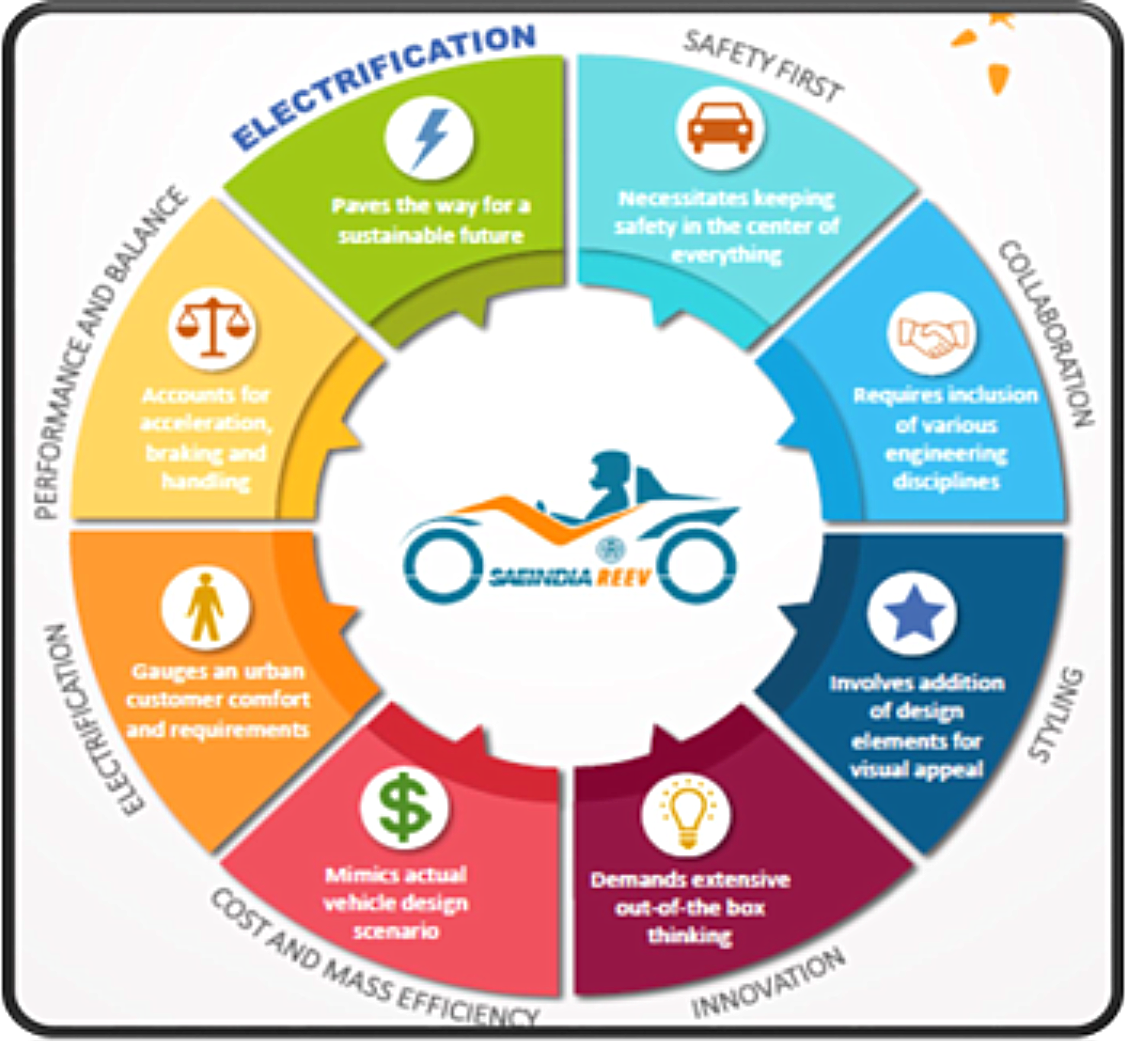
REEV design consideration wheel: electrification paves the way for a sustainable future, safety first keeps safety central, collaboration requires various engineering disciplines, styling adds visual appeal, innovation demands out-of-the-box thinking, cost and mass efficiency mimics actual vehicle design scenarios, ergonomics gauges urban customer comfort, and performance and balance accounts for acceleration, braking and handling
REEV 4.0 format

A two-phase season, virtual first.

Every team moves through the same two phases, on the same architecture standard.

PhaseWhat happens
Phase 1 — Virtual REEV 4.0Technical sessions on IPG CarMaker, ANSYS and MATLAB, then REEV Virtuals: teams present preliminary design and simulation results to a judging panel, plus a bench-video Hybrid Bench checkpoint proving the powertrain runs before any hardware is cut.
Phase 2 — On-Ground FinalsTeams bring the completed, fabricated vehicle to the finals venue for safety scrutiny, technical inspection, and a dynamic on-road run in front of the jury.
Where REEV happens

Host universities.

REEV's finals are hosted on partner campuses with the lab, track and auditorium space a live vehicle competition needs.

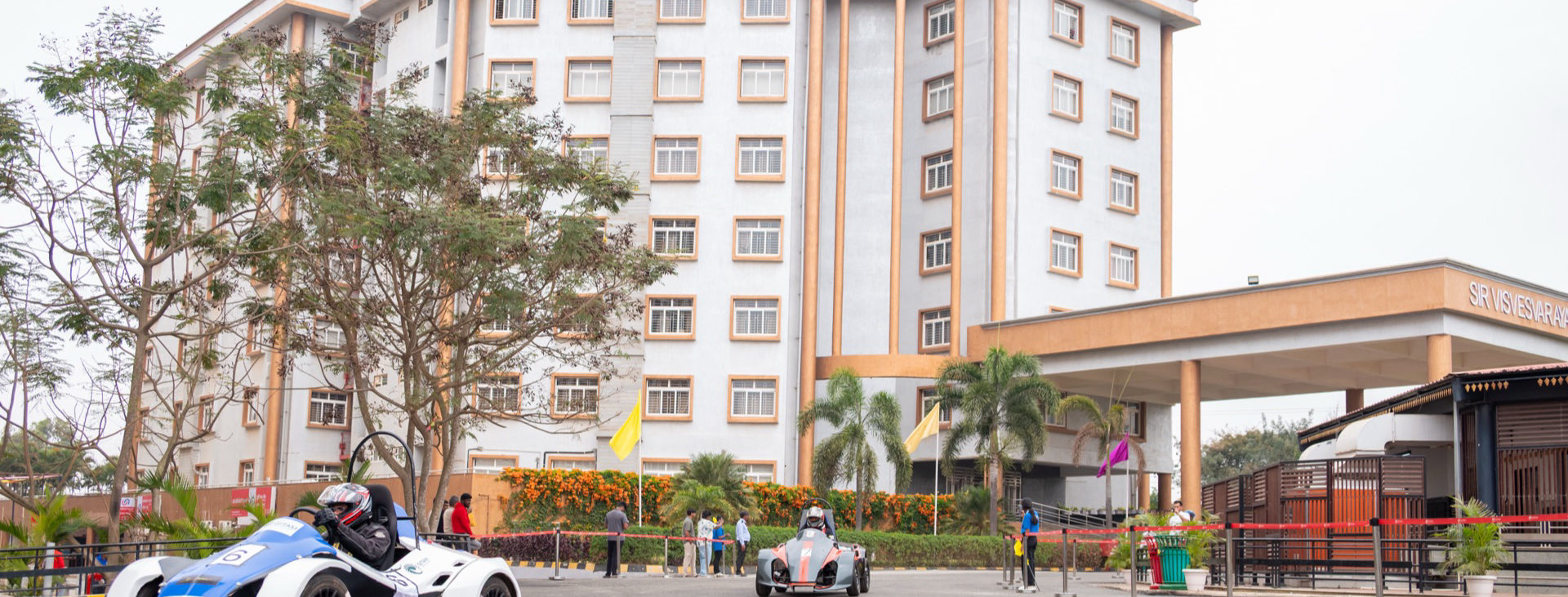
GITAM University's Bengaluru campus building, with REEV vehicles on track in the foreground

GITAM (Deemed to be University), Bengaluru

GITAM's Bengaluru campus — established in 2012 and accredited NAAC A++ — hosted REEV's 3rd Edition finals in January 2026: the largest edition to date, capped with a 2nd Runner-up finish and the inauguration of an Electrical Vehicle Centre of Excellence on campus.

Set on a ~50-acre campus at Nagadenahalli, Doddaballapur Taluk, close to Kempegowda International Airport, it runs four schools — Technology, Business, Science, and Humanities & Social Sciences — with smart classrooms, AI/IoT/robotics labs, a central library holding 80,000+ resources, and a full auditorium, making it well suited to run technical sessions, a jury floor and a dynamic run all on one site.

Get involved

Join REEV — as a student, mentor, or SME.

REEV runs on three kinds of people outside the competing teams. Pick the one that's you.

Student

Volunteer / Tech Team

Run registration desks, technical sessions and finals-day logistics as part of the student Event Support Team.

Register as a Student ↗
Mentor

Faculty & Industry Mentor

Guide a team end-to-end through the season — design reviews, simulation checkpoints and build sign-off.

Register as a Mentor ↗
SME

Subject Matter Expert

Judge design presentations, hybrid bench evaluations and finals, or advise on a specific technical area.

Register as an SME ↗